Health insurance is one of the most powerful tools a small business owner can use to attract and retain great employees. But choosing a plan that’s affordable, flexible, and compliant with the Affordable Care Act (ACA) is harder than it should be.
For most small businesses, offering health insurance is a way to attract and retain top talent, enhance employee satisfaction, and boost productivity. In fact, we recently found that 73% of small business owners believe offering competitive benefits is important to their business’s overall success.
Balancing affordability, coverage, and compliance is no small feat when looking for the best health insurance for your small business. With complex insurance terms, varying coverage levels, and unpredictable premium hikes, identifying the best fit can feel overwhelming.
Thatch is not an insurance provider, but as a platform specializing in ICHRA plans, it can simplify this process by helping business owners understand and evaluate their options, empowering them to make informed decisions that suit both their business goals and employees' healthcare needs.
Why do small businesses need health insurance?
Offering health insurance isn’t legally required until you have 50 full-time equivalent (FTE) employees. But most small employers are interested in offering more than the bare minimum.
56% of small firms (10 to 199 workers) that offer health benefits provide at least one wellness program (such as smoking cessation, weight management, or behavioral coaching).
29% of covered workers at small firms are in a plan where the employer pays the entire single-coverage premium, versus 7% at firms with 200 or more workers.
35% of small firms offering health benefits give workers the option to complete a health risk assessment, a health-management add-on beyond basic coverage.
[source: KFF 2025 Employer Health Benefits Survey]
A strong health plan signals stability and care. It reduces churn. It saves time on hiring. And thanks to HRAs and tax credits, you don’t need a corporate-sized budget to do it.
What are the types of small business health insurance?
Small business owners face various choices, from traditional group plans to flexible, tax-advantaged options like Individual Coverage Health Reimbursement Arrangements (ICHRAs).
Choosing the right plan for your small business depends on your company’s size, budget, and the level of risk you are comfortable taking on. Let’s look at the primary types of small business health insurance plans available today.

Small-group insurance (HMO, PPO)
Best for: Small businesses seeking straightforward plans with network-based coverage for all employees.
Small-group insurance is the traditional approach to employer-sponsored health coverage. It offers standardized plans through an insurer that covers all eligible employees. Those plans are often in the form of a Health Maintenance Organization (HMO) or a Preferred Provider Organization (PPO).
HMO (Health Maintenance Organization) is a plan that emphasizes preventive care and typically requires employees to use a specific network and select a primary care provider.
Pros:
Lower premiums and out-of-pocket costs
Emphasis on preventive care
Cons:
Limited to a specific network of providers
Requires referrals for specialist visits
PPO (Preferred Provider Organization) plan offers greater flexibility to see specialists without referrals and allows for out-of-network care, albeit at higher costs.
Pros:
Greater flexibility to see specialists without referrals
Allows for out-of-network care
Cons:
Higher premiums and out-of-pocket expenses
Costs increase with out-of-network providers
Self-funded plans
Pros:
Significant cost savings compared to traditional plans
Flexibility to customize coverage to fit employee needs
Avoids paying fixed premiums to insurers
Cons:
High financial risk from unpredictable claims
Requires resources to manage claims and compliance
Stop-loss insurance may add additional costs
With self-funded (or self-insured) plans, businesses pay for employee health claims directly rather than through fixed premiums to an insurer.
While self-funding can offer substantial cost savings and customization options, it also comes with higher financial risk, especially if claims are unexpectedly high.
Best for: Businesses with the financial stability and resources to manage claims directly while seeking more control over plan design and costs.
Level-funded plans
Best for: Businesses with the financial stability and resources to manage claims directly while seeking more control over plan design and costs.
Level-funded plans are a middle ground between fully insured and self-funded plans, providing businesses with fixed monthly payments to cover expected claims and administrative costs. You still self-fund but partner with a stop-loss insurer who takes over financial responsibility if claims exceed a pre-determined amount.
If claims are lower than expected, employers may receive a refund at the end of the year. This option offers more cost predictability than self-funded plans while still allowing for potential savings.
Pros:
Fixed monthly payments provide cost predictability
Potential for refunds if claims are lower than expected
Includes stop-loss coverage to minimize financial risk
Cons:
May require more administrative oversight than fully insured plans
Refunds are not guaranteed if claims exceed expectations
Health Reimbursement Arrangements (HRAs)
Best for: Small businesses looking for a customizable, tax-efficient way to help employees with healthcare costs without managing a traditional group plan.
HRAs enable businesses to reimburse employees for medical expenses, offering flexibility and potential tax advantages. You basically contribute funds to a tax-advantaged account that employees can use to pay for qualified medical expenses.
Two popular types of HRAs for small businesses include:
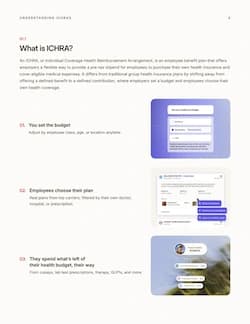
Individual Coverage HRA (ICHRA): ICHRAs allow employers to reimburse employees for individual health insurance premiums and other qualified medical expenses on a tax-free basis. ICHRAs offer a flexible and scalable solution ideal for small businesses, especially if you want to avoid the cost and administration of a traditional group plan.
Qualified Small Employer HRA (QSEHRA): QSEHRAs are similar to ICHRAs but have specific eligibility requirements, including being available only to businesses with fewer than 50 employees and not offering a group health plan. Like ICHRAs, QSEHRAs allow for tax-free reimbursements but come with annual contribution limits set by the IRS.
Pros:
Flexible reimbursement for medical expenses or premiums
Tax advantages for both employers and employees
Reduces administrative burden compared to traditional group plans
Cons:
Annual contribution limits for QSEHRAs
Limited eligibility and compliance requirements
How to choose the right health insurance for your small business
Choosing the best health insurance plan for your small business involves balancing cost, coverage, and ease of management. Here are a few important details to help guide your decision.
Budget
Start by setting a clear budget. As we’ve established, health insurance is a significant expense. Consider how much you’re willing to contribute each month and explore cost-control options like ICHRAs or level-funded plans, which can help with predictability.
Employee demographics
Your employees’ needs should also play a role in your decision. Key factors to consider include:
Age: Older employees or those with families might need more comprehensive coverage.
Health status: If employees have chronic conditions, they may benefit from plans with low deductibles and robust coverage.
Flexibility preferences: Some employees may prefer having the option to choose their own plan.

Compliance
Ensure your plan meets federal and state regulations. Small businesses with fewer than 50 employees aren’t required to offer insurance. If you choose to do it, you must comply with the Affordable Care Act (ACA), such as covering essential health benefits and meeting minimum value standards.
Network coverage
Consider the plan’s network, especially if your employees live in different areas. A plan with a national network or a flexible PPO may be best for a geographically diverse workforce. HMOs, while more affordable, may restrict employees to a smaller network of providers.
Administrative burden
Some plans are simpler to manage than others. Here’s a quick comparison:
Traditional group plans: Often require more ongoing management and compliance oversight.
HRAs: Offer flexibility, allowing employees to manage their own coverage, which can reduce administrative tasks.
Self-funded and level-funded plans: May require a third-party administrator but can offer savings and customized plan design.
Carefully evaluating these aspects can ensure you choose the best health insurance solution for your business — one, like Thatch, that meets compliance standards, provides meaningful coverage, and adapts to the needs of your workforce.
How do these options work?
Understanding the mechanics of small business health insurance plans can help you choose the right fit for your business. Each type of plan has unique features, but the general processes for enrollment, premium payments, and claims administration are relatively consistent across options:
Enrollment
During an annual open enrollment period, employees can sign up for coverage or update their choices. The employer may offer different plan options with varying levels of coverage and costs.
Employers may work with an employee benefits broker to navigate the selection and enrollment processes, ensuring compliance with healthcare regulations.
Paying premiums
With traditional group plans and HRAs, employers typically pay a portion of the premium, with employees covering the remaining cost through payroll deductions.
Level-funded plans have a fixed monthly payment that combines premium costs and expected claims.
Self-funded plans don’t involve regular premiums. Instead, employers cover employees’ claims as they arise, which can fluctuate based on healthcare usage.
Claims administration
When employees incur medical expenses, they submit claims to the insurance company for traditional plans, an HRA administrator, or a third-party administrator (TPA) for self-funded and level-funded plans.
The employee’s plan then determines their specific coverage and pays the provider or reimburses the employee directly.
Employer and employee responsibilities
The responsibilities of employers and employees vary slightly depending on the plan structure.
Employers cover a portion (or all) of the premiums or reimbursement costs and ensure the plan meets regulatory requirements.
Employees are responsible for choosing appropriate providers and managing out-of-pocket costs, such as deductibles or copays.
For ICHRAs and QSEHRAs, employees must select their health insurance policies, giving them more control and greater responsibility in managing their healthcare coverage.
How much does small business health insurance cost?
According to KFF's 2025 Employer Health Benefits Survey, average annual premiums for employer-sponsored family coverage rose 6% in 2025 to $26,993.
Several factors are at play in determining the cost of small business health insurance, each of which can cause these premiums to vary widely:
Industry: High-risk fields, like manufacturing or construction, tend to have higher premiums, while lower-risk sectors, like tech, usually pay less.
Location: States with higher healthcare costs and more regulations, such as New York and California, often have more expensive premiums.
Employee demographics: Older employees or those with chronic conditions may increase average premium costs.
Plan design also impacts costs. With an ICHRA, employers set a fixed monthly reimbursement allowance rather than absorbing unpredictable premium increases each year. That predictability matters: according to KFF's 2025 Employer Health Benefits Survey, average employer-sponsored family premiums have risen 26% over the past five years, reaching $26,993 annually.

Understanding health insurance pricing is crucial for setting realistic expectations and budgeting effectively.
When analyzing employer-sponsored coverage, the KFF 2025 Employer Health Benefits Survey found:
Average annual premium: $9,325 for single coverage and $26,993 for family coverage
Average worker contribution: $1,440 for single coverage and $6,850 for family coverage
Self-funded and level-funded plans offer alternatives for businesses seeking more control over their healthcare costs.
These plans can vary widely in cost, depending on factors like claims experience and risk tolerance. If claims are low, there is savings potential for both employers and employees.
Additional factors like deductibles, copays, and coinsurance also affect the total cost for both employers and employees.
An employee benefits broker can help you obtain specific quotes tailored to your company’s needs. This approach helps ensure the chosen plan aligns with your budget and coverage goals.
Major health insurance providers for small businesses
Several large carriers write small-group and individual coverage across much of the U.S. Four of the most widely available are Kaiser Permanente, Anthem, UnitedHealthcare, and Blue Cross Blue Shield.
Kaiser Permanente runs an integrated model that combines insurance with its own hospitals and physician groups, available in select states including California, Colorado, and parts of the Pacific Northwest.
Anthem offers HMO, PPO, and high-deductible health plans in the states where it operates.
UnitedHealthcare offers small-group and individual plans and operates a large national provider network.
Blue Cross Blue Shield is a federation of independent regional companies offering small-group coverage in most states.
Plan availability and pricing vary by state and by year. Under an ICHRA, employees can put their allowance toward any qualifying individual plan available in their area, regardless of carrier.
How Thatch can help you choose
Navigating health insurance options can be overwhelming for small business owners, but Thatch simplifies the process by guiding you through each step. We offer an all-in-one ICHRA platform, allowing you to offer personalized health benefits without the complexities of traditional group plans.

Thatch gives you access to tools and resources designed to make health insurance straightforward. Key features include:
Personalized guidance: Our platform helps identify the best health insurance options for your employees to consider.
Streamlined reimbursements: Easily set up ICHRAs to reimburse employees for their individual health insurance plans, saving you time and reducing administrative tasks.
Compliance support: Our tools ensure that your health benefits meet legal requirements so you can stay compliant without added stress.
Ready to explore how Thatch can help? Schedule a demo to see how easy it can be to offer health benefits that work for your business.
FAQ
Do small businesses have to provide health insurance to employees?
Small businesses are only required to provide health insurance to employees if they have 50 or more full-time employees. In this case, they must comply with the ACA's employer mandate.
Can small businesses write off health insurance?
Yes, small businesses can typically deduct the cost of health insurance premiums as a business expense. This applies to both group health plans and individual plans for owners and employees.
Consult with a tax professional to understand the specific deductions available to your business.
What is the best option if an employee has a pre-existing condition?
The best option for employees with pre-existing conditions is to offer a health insurance plan that covers them without exclusions, such as an individual plan through the marketplace. An ICHRA is another good choice since it allows employees to choose their own coverage.
Under the Affordable Care Act, insurers cannot deny coverage or charge higher premiums based on pre-existing conditions.
Can I offer health insurance to just one employee?
With ICHRA, yes. You can even offer different reimbursement levels by class of employee (e.g. salaried vs hourly).
How does ICHRA compare to a group plan?
ICHRA is more flexible, typically cheaper, and easier to scale. Employees buy their own plan, and you reimburse them tax-free.
Is a broker required to set up small business health insurance?
Not always. If you’re offering group coverage, a broker can help. If you’re using an HRA, you just need an admin platform like Thatch.
What if an employee declines coverage?
Employees can waive coverage, especially if they have access to a spouse’s plan or individual coverage. You’ll need a signed declination form for your records.
Can owners participate in small business health insurance?
Yes, but eligibility varies. S-corp owners with >2% ownership are treated differently than C-corp owners or LLC members. Check with your CPA to avoid compliance issues.
What happens if my business grows past 50 FTEs?
Once you hit 50 full-time equivalent employees, you’re considered an Applicable Large Employer (ALE) under the ACA. That means you’re required to offer affordable coverage or face penalties. Planning ahead helps ensure a smooth transition.
Empower your small business with ICHRA
There’s value in offering competitive benefits to your employees. But we understand that you may feel overwhelmed trying to figure out which type of health insurance is best for your company and staff.
Individual Coverage HRAs (ICHRAs) offer a flexible and cost-effective solution. ICHRAs can help you attract and retain top talent without breaking the bank by reimbursing employees for individual health insurance premiums.
Thatch can help you navigate the complexities of ICHRA and find the perfect plan for your business.
Small business health plan resources
For more details on rules, coverage, and compliance, check out these official resources:
These sites offer up-to-date guidance and legal definitions if you want to go deeper or verify plan specifics.